shopping_basket
Cart
0
Chat
Phone Messenger WhatsApp

Shopping Cart

0 Items

Sub Total

0.00

Total

0.00

DAC CABLE 10G 1 METER

DAC CABLE 10G 1 METER

৳ 1,100

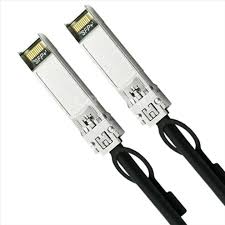
This is a 10G SFP+ Passive Direct Attach Copper (DAC) Cable with a length of 1 meter. It is a high-performance, cost-effective solution for 10 Gigabit Ethernet and 10G Fibre Channel applications. This twinaxial copper cable features SFP+ connectors on both ends and is designed for short-distance, in-rack connections between network switches, servers, routers, and storage systems .

  • Specifications
  • Details
  • Reviews
  • Videos
FeatureSpecification
Product TypeDirect Attach Copper (DAC) Cable
Data Rate10 Gbps (10 Gigabit Ethernet)
Length1 meter (3.3 feet)
Connector TypeSFP+ to SFP+
Cable TypePassive Twinaxial Copper (Twinax)
Wire Gauge (AWG)30 AWG
Impedance100 Ohm
Power Consumption< 0.5W per end (Very low)
Jacket MaterialPVC (OFNR)
Minimum Bend Radius20mm
Operating Temperature0°C to 70°C (32°F to 158°F)
Storage Temperature-40°C to 80°C (-40°F to 176°F)
Hot-SwappableYes (MSA Compliant)
Protocols Supported10G Ethernet, 1G Ethernet, 10G Fibre Channel, InfiniBand
CompatibilityMSA Compliant switches, routers, servers (works with major brands like Cisco, Juniper, Netgear, MikroTik, Ubiquiti, D-Link, TP-Link, and more)

The 1-Meter 10G SFP+ Passive Direct Attach Copper (DAC) Cable is a specialized networking cable designed for high-speed, short-distance connections within data centers, server rooms, and enterprise networks. It provides a reliable and cost-effective alternative to fiber optic transceivers and cables for connections up to 1 meter .

Technology & Construction:
This cable integrates two SFP+ connectors with a fixed length of twinaxial copper cable. Unlike traditional Ethernet cables (Cat5e/Cat6), which use RJ45 connectors and require separate transceiver modules, a DAC cable has the transceiver functionality built directly into the connector housing. This integrated design eliminates the need for two separate SFP+ optical modules and a fiber patch cable, simplifying deployment and reducing points of failure .

Passive vs. Active:
This specific cable is a passive DAC cable. Passive DAC cables do not contain any active electronic components to boost the signal; they rely solely on the copper conductors to transmit the electrical signal. Because of this, they consume extremely low power (less than 0.5W per end), generate negligible heat, and have ultra-low latency . Passive DAC cables are best suited for short distances (typically up to 5-7 meters), making the 1-meter length ideal for in-rack connections where devices are stacked directly on top of each other or adjacent within the same rack.

Key Advantages:

Cost-Effective: Significantly less expensive than purchasing two separate SFP+ optical transceivers and a fiber optic patch cable .

Low Power & Low Latency: Consumes minimal power and introduces virtually no signal delay, making it ideal for high-performance computing and financial trading applications .

Reliability: The integrated design and rugged copper construction offer high reliability for short links, with less risk of dirt or damage compared to optical connectors .

Plug-and-Play: Hot-swappable, meaning it can be inserted or removed from a live device without powering it down. No configuration is required .

Flexibility: Despite being a copper cable, twinaxial cable is more flexible than standard Ethernet patch cables, making it easier to route in tight spaces within a rack.

Compatibility:
This DAC cable is manufactured to be compliant with MSA (Multi-Source Agreement) standards, ensuring interoperability between SFP+ ports from different vendors . It works with any standard SFP+ port on a wide range of networking equipment, including:

Network Switches

Servers (with SFP+ NICs)

Routers

Network Attached Storage (NAS) devices

Firewalls

While compatible with most MSA-compliant equipment, some manufacturers (like Cisco, Juniper, Dell, Arista, Fortinet) have specific coding requirements. For those cases, coded versions of this cable are available .

Applications:

In-Rack Switching: Connecting a top-of-rack (ToR) switch to servers within the same rack.

Stacking: Stacking switches together to form a single logical unit (depending on switch support).

Storage Connections: Connecting servers to storage arrays or NAS devices.

Data Center Interconnects: Short-haul connections between adjacent networking equipment.