Stock Out
Suggested Products
Stock Out


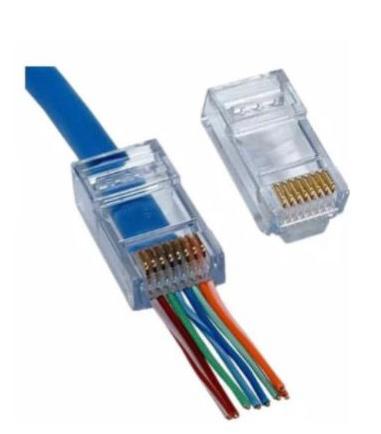
The defining feature of this BDPON Perforation RJ45 Connector is its innovative Through-Hole design. Unlike standard connectors where the wire stops inside the plug, this design includes an open slot at the front end, allowing the installer to push the wire completely through for accurate alignment and visual verification.
Preparation: Strip the cable jacket and untwist the pairs.
Arrangement: Arrange the wires according to the T568A or T568B standard.
Insertion: Push the wires through the connector body and out of the front slot.
Verification: Visually check the order through the connector body and the front slot to ensure the sequence is correct.
Crimping: Use a standard pass-through RJ45 crimping tool to cut the wires flush and seat the contacts simultaneously.
This connector is generally designed for CAT5E and CAT6E UTP cables, supporting solid and stranded conductors from 23 to 24 AWG. It maintains the signal integrity required for Gigabit Ethernet and Power over Ethernet (PoE) applications, making it ideal for custom-length patch cables or repairing broken RJ45 ends.
Have question about this product? Get specific details about this product from expert.
There are no questions asked yet. Be the first one to ask a question.
Stock Out